Settings can be adjusted at any time by visiting the dashboard. The first few changes you will make to your site are:
- Selecting your time zones
- Selecting your site visibility
- Deleting the sample pages and posts
Be sure to read the Terms of Use.
Selecting your Time Zone
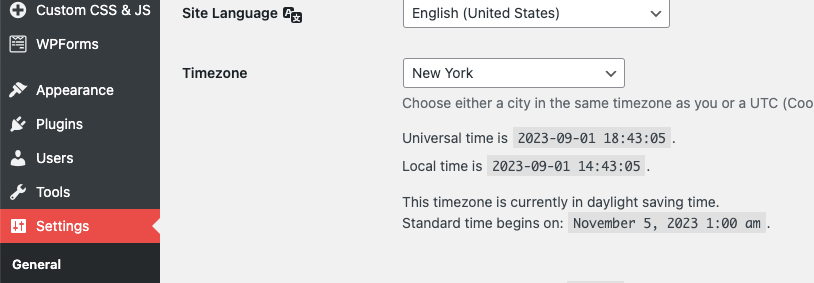
This is the time zone setting that will determine the times and dates listed on your posts, comments, etc. Choose the major city in your current time zone. We will choose New York so our site operates on Eastern Time (ET).
From your Dashboard
- Select Settings on the left Admin Sidebar.
- Select General.
- Scroll down to Timezone and select New York in the drop-down menu.
- Be sure to save your changes by clicking the “Save Changes” button on the bottom left of the page.
Take note of the other settings on this page for future edits, like your site title and tagline.
Selecting your Site Visibility
The site visibility setting refers to the entire site. Users may choose to limit the audience of individual posts or pages of the site, but this setting is the default for the whole site.
The explanations for the choices for site availability are listed below the image, but we recommend that you do not restrict your site below “Visible to only registered users of this network”. A more restricted site will make it difficult for your professors and peers to visit your site, a very common practice in many of the courses at UNE. The site visibility setting may be changed at any time. Students who choose to share their ePortfolio site with grad schools or potential employers should set their site visibility to one of the public options.
From Settings on the left Admin Bar:
- Select Reading.
- Scroll down to “Site visibility”.
- Choose the radial button next to your option.
- Be sure to save your changes by clicking the “Save Changes” button on the bottom left of the page.
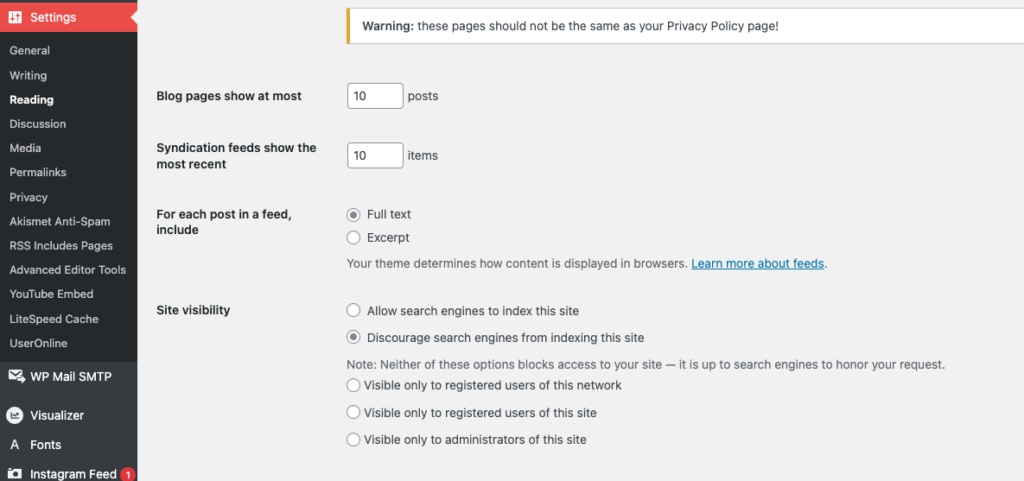
- Allow search engines to index site: your site is a public site. Anyone with the URL may view the site. Typically, ePortfolio sites do not generate enough traffic to be noticed by search engines unless the URL is being shared widely (ex. on a LinkedIn profile or other social). This is the default setting for an ePortfolio site. (Recommended)
- Discourage search engines from indexing this site: your site is a public site. Anyone with the URL may view the site. As noted in the settings, search engines are discouraged (but not required) to honor your request. (Recommended)
- Visible only to registered users of this network: your site is visible to other UNE ePortfolio users. Only those users who are part of the UNE Portfolio Network may view the site. This typically includes classmates and professors, but only those who are registered users of the UNE Portfolio Network. Others will get a login screen. (Recommended)
- Visible only to registered users of this site: your site is visible only to UNE Portfolio Network users whom you have chosen to have access to your site. If you only want your site to be visible to specifc people in the UNE Portfolio Network, you will add them individually by going to “users” from the dashboard. This option is not recommended since you will need to adjust it frequently (at least every semester), including adding specific professors.
- Visible only to administrators of this site: your site is visible only to you and a few UNE IT and SASC administrators. Your site is not visible to professors, classmates, advisors, etc.
Deleting Posts and Pages
These are actions you use to manage content on your site. You may initially choose to keep these samples as you experiment and learn, but we will go over the process since some of you will prefer to start with a clean slate.
To delete a post:
- Select Post in the left Admin Bar
- Select the Post you would like to delete – in this case, “Hello World!”
- Select “Trash” to delete the post

Under Posts, select “Hello World” and then “trash” to delete the sample post.
To delete a page:
- Select Page in the left Admin Bar
- Select the Post you would like to delete – in this case, “Sample Page!”
- Select “Trash” to delete the post
Under “Pages,” select “Sample Page” and then “trash” to delete the sample post.

FYI – Accidental deletions of pages and posts can be restored for 30 days from the trash, and you can delete multiple items by selecting them and using the “Bulk Action” drop-down menu
Briefly, the difference between a page and a post is below. More details are here.
- Post: A blog entry or article that appears in reverse chronological order on your blog page. Posts are dynamic, time-stamped content often used for news, updates, or journals. They can be categorized and tagged. Often open to comments from visitors.
- Page: Static, timeless content like “About,” “Contact,” or “Privacy Policy.” Pages do not use categories or tags and are not listed by date. A comment block can be added to a page for visitor responses.
- In short, posts are timely and blog-like, while pages are static
